


What the Wealthiest Americans Want from Their Financial Advisors
Key Takeaways:
Advisors’ brand recognition and expertise, is highly valued by the ultra-wealthy. Advisors who coordinate the efforts of other professionals get high marks. Specialization, serving clients who are similar in some key way, is a trait the ultra-wealthy like to see.
What should you be looking for when seeking out insights and advice on your financial journey?
The answer is “it depends”, there are a range of factors and issues that will inform what you need. However, you can potentially gain plenty of good ideas by seeing what the wealthiest among us look for and care about when it comes to working with financial professionals. Armed with (essentially) the best practices of these highly successful people, you can look for talent that possesses the key traits and attributes.
With that in mind, here’s what the ultra-wealthy, those with a net worth of more than $25 million tell us about the professionals they choose to work with, and why.
A Diverse Lineup of Advisors: So just who are the ultra-wealthy working with when it comes to their wealth? Not surprisingly, as shown in Exhibit 2, it’s a diverse range of professional advisors. Accountants (44.6%) lead the pack, followed by independent investment advisors (RIAs) (34.6%) and full-service brokers (34.4%). When selecting a primary advisor, independent investment advisors and full-service brokers are the top options among the ultra-wealthy (see Exhibit 3).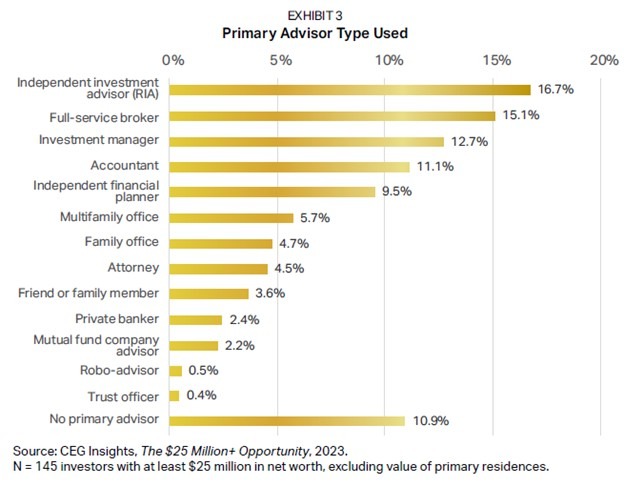
Ultra-wealthy investors engage multiple advisors for a number of reasons. Many see additional safety in diversification of both their investments and the expertise they receive. Some seek a more integrated approach to wealth management by working with advisors with different areas of focus. Others are interested in seeing how their advisors compare to one another essentially creating a situation where they compete with one another. However, working with multiple advisors in this way also creates potential challenges for investors, including the risk of conflicting advice, overlapping investments and administrative complexities.
Of course, you don’t need to have anywhere near $25 million to benefit from assembling a group of financial professionals such as an accountant, advisor, attorney and banker. Your particular goals and needs should inform which types of experts you believe are most necessary to pursuing your objectives.
Brand Recognition: Brand recognition is an important factor in advisor selection among the ultra-wealthy, with over three-quarters (75.8%) preferring services and products that have strong brand recognition. Along the same lines, 70.8% of these investors prefer to work with the best firms in the industry, regardless of whether they have a nearby office (see Exhibit 4).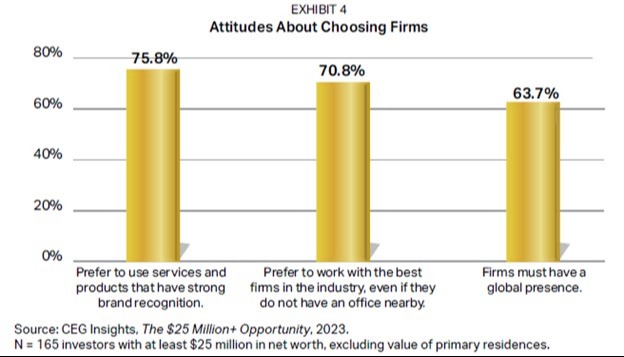
It’s important to recognize that brand recognition doesn’t necessarily mean the professionals who advertise the most. It’s often more about the professionals being recognized in the marketplace as true experts thought leaders who possess the insights and skills to meaningfully help their clients.
For example, when it comes to professional services, virtually everyone among the ultra-wealthy prefers to work with people who are seen as experts who can address their needs effectively. Among the respondents, the overwhelming majority cited responsiveness (96.7%), knowledge and expertise (95.1%), and communication (92.8%) as important features for any firm they engage. Investment performance was fourth at 87.8%.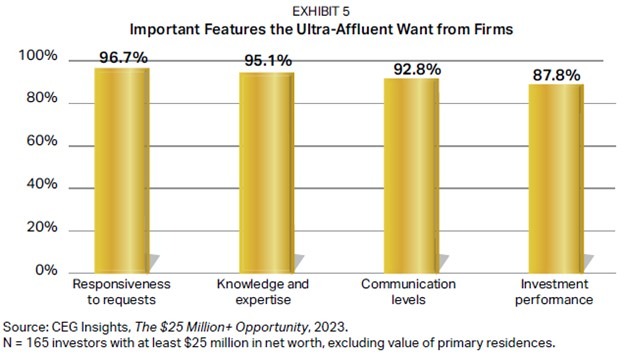
Ultimately, it’s a good idea to assess advisors you work with (and advisors you’re considering doing business with) on the factors that are most important to you which may overlap with the areas that are important to the ultra-wealthy, such as responsiveness, communication levels and overall expertise.
A Desire for Specialists: Most of the ultra-wealthy are not interested in engaging advisors who work with clients of any wealth level, age or stage in life. Not surprisingly, these investors want to work with advisors who specialize in serving clients like them (and who will thus deliver the expertise required to meet their particular needs).
According to CEG Insights (see Exhibit 6), more than half (54.1%) of ultra-wealthy investors overall want to work with advisors who serve clients who are similar in age to the investors; more than four in ten (43.8%) want their advisors to work with clients of a similar wealth level.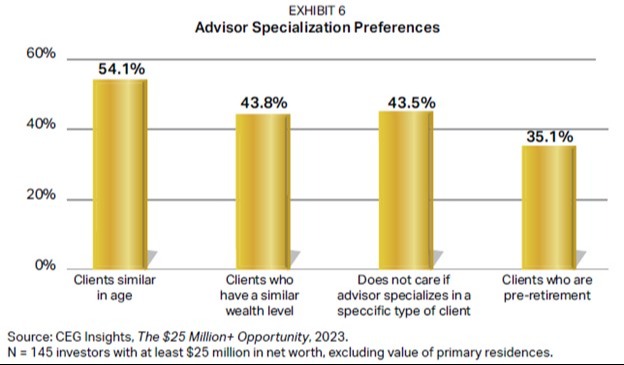
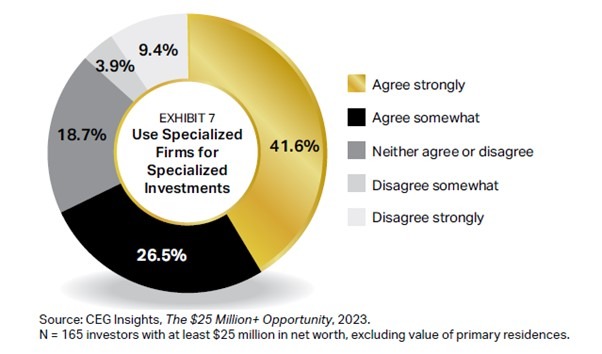
In addition to wanting to work with advisors who specialize in serving clients of similar age and wealth, many of the ultra-wealthy turn to specialized firms for specialized investments. More than two-thirds (68.1%) of our respondents engage firms that focus on providing the particular investments they have or want (see Exhibit 7).
The message for you as an investor here is that it can be a good idea to work with professionals with clients who are similar to you in some foundational ways. More financial professionals these days are focusing on serving one client type or demographic (or perhaps a handful) such as physicians, executives in a particular industry or women in transition rather than trying to “be everything to everyone.” Working with professionals who have a deep understanding of your situation based on your age, career, level of net worth or other key factors can potentially lead to more targeted advice that reflects your unique needs and challenges.
Coordinated Delivery of Solutions: Based on the various types of financial professionals they use, it’s pretty clear that the ultra-wealthy are looking for more than just investment management. They want a full range of advanced planning services to address their myriad financial and nonfinancial concerns. Just as important, they want those services coordinated in order to optimize their ability to achieve what is most important to them.
Here’s one simple example of this desire for coordination. Among our survey respondents, seven in ten (70.3%) want the ability to see all of their account balances in one place, including those held at multiple firms and institutions.
More evidence that the ultra-wealthy would appreciate coordination of their financial lives: Four out of five (80.3%) believe that it is either extremely or somewhat important for their advisor, accountant, attorney or other financial professionals to communicate with one another about optimizing their financial situation.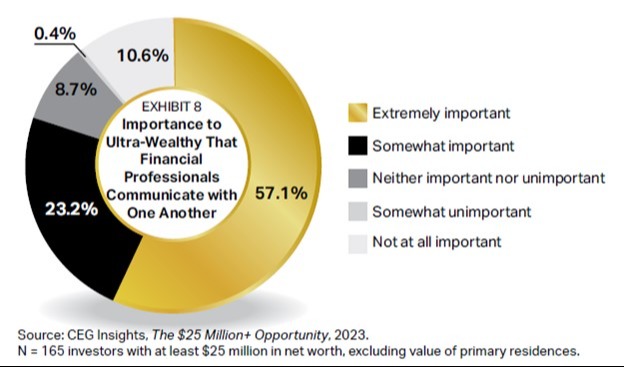
This type of coordinated effort, in which various professionals communicate with each other about shared clients and work in concert to identify solutions, can be an extremely powerful approach to managing wealth. For one, it can better ensure that every expert is “on the same page” thereby avoiding a situation in which (for example) a strategy implemented by an accountant clashes with a solution implemented by an investment manager.
It’s therefore a good idea to inquire whether the advisors you work with either are part of a coordinated team or coordinate a team of experts themselves.
Conclusion: Ultimately, you may or may not agree with these preferences seen among the ultra-affluent. That said, it seems likely that the prospect of working with advisors who:
A) serve other people in situations similar to yours,
B) are recognized thought leaders in their fields, and
C) coordinate their efforts with other financial professionals will sound very appealing.
If so, consider making a focused effort to identify such professionals and work with those you feel can best position you for the road ahead.
DISCLOSURE: Robert W. Baird & Co. Incorporated is not a legal or tax services provider and you are strongly encouraged to seek the advice of the appropriate professional advisors before taking any action. Baird No: COD00045294. ACKNOWLEDGEMENT: VFO Inner Circle Special Report, By John J. Bowen Jr., © Copyright 2025 by AES Nation, LLC. All rights reserved. No part of this publication may be reproduced or retransmitted in any form or by any means, including but not limited to electronic, mechanical, photocopying, recording or any information storage retrieval system, without the prior written permission of the publisher. Unauthorized copying may subject violators to criminal penalties as well as liabilities for substantial monetary damages up to $100,000 per infringement, costs and attorneys’ fees. This publication should not be utilized as a substitute for professional advice in specific situations. If legal, medical, accounting, financial, consulting, coaching or other professional advice is required, the services of the appropriate professional should be sought. Neither the author nor the publisher may be held liable in any way for any interpretation or use of the information in this publication. The author will make recommendations for solutions for you to explore that are not his own. Any recommendation is always based on the author’s research and experience. The information contained herein is accurate to the best of the publisher’s and author’s knowledge; however, the publisher and author can accept no responsibility for the accuracy or completeness of such information or for loss or damage caused by any use thereof.