


Defining Success: Professional, Personal and Financial
Key Takeaways:
For many, true success involves having a positive impact on others. Financial success is mostly linked to specific goals, not a specific net-worth amount. Some big generational differences exist when it comes to defining success.
The concepts of success and wealth are inextricably linked in our world today. We often seek to understand the drivers behind the success and wealth of the most affluent people and families so we can attempt to harness those same forces ourselves.
But what many of us don’t do enough is examine the idea of success and importantly what it actually means to each of us, as well as the role that wealth plays in how we define a successful life.
With that in mind, CEG Insights surveyed more than 1,200 affluent individuals about how they think and feel about success and what they believe contributes to them having successful lives.[1]
A High Level Take on Success: For many of the affluent, the days when financial prosperity equaled success are over. Today, we find that success usually encompasses a broader spectrum of outcomes that includes personal and professional fulfillment, happiness and a greater sense of purpose.
Consider how the affluent define success broadly. Not surprisingly, success means different things to different people, and the definition varies along with individual values, priorities and life stages. However, when asked to name their number one definition of success, a few commonalities emerged (see Exhibit 2).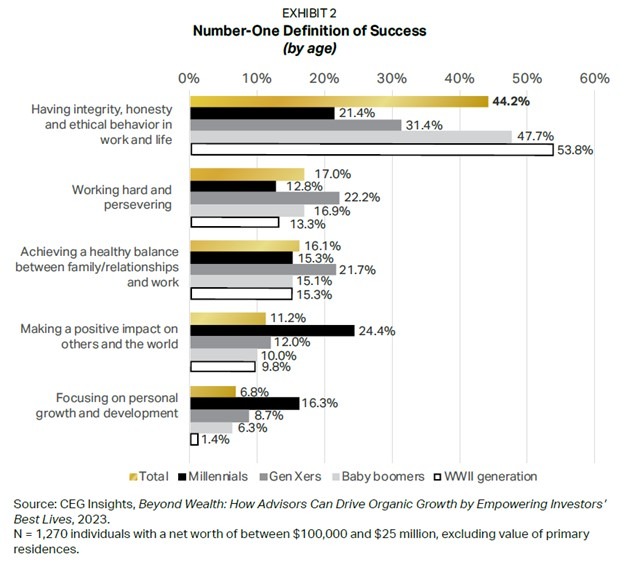
Note the top answer, cited by 44.2% of people: having integrity, honesty and ethics at work and in life. No other response came close. The other top definitions, overall, were “working hard and persevering” and “achieving a healthy balance between family/relationships and work,” cited by roughly the same percentage of people. Given the push-pull dynamic between those two outcomes, not to mention how challenging it may be to consistently act with integrity, it’s little wonder why many people feel uncertain as to whether they’re truly successful.
That said, there are important differences here based on the respondents’ generation. For example:
- While “making a positive impact on others and the world” was the top definition of success for just 11.2% overall, it was paramount for nearly one-quarter (24.4%) of millennials.
- Millennials also place a big emphasis on personal growth and development (16.3% vs. 1.4% of WWII investors).
- Gen X is interested in working hard and persevering (22.2%) not surprising given that they’re the generation that most intensely experienced the transition from an analog to a digital world, making its members adept at adapting to new and challenging situations.
- Gen X is also even more likely than millennials to put emphasis on achieving a healthy work/life balance (21.7% vs. 15.3%), as many of them are sandwiched between raising their own children and caring for aging parents.
What Does Financial Success Look Like? From a financial point of view, the majority of investors (73.4%) say that having enough money for retirement is the ultimate sign of success. Being able to afford one’s lifestyle (66.5%) and being debt-free (58.5%) rounded out the top three most important factors in defining financial success.
What’s more, a relatively small number of investors, less than 10% overall, define financial success in terms of acquiring a specific amount of money. This suggests to us that wealth viewpoints have more to do with reaching goals than with seeing how many zeros or commas can be added to a net-worth number.
But here again, there are generational distinctions. For example, investors still young enough to be in the workforce, millennials (22.1%) and Gen Xers (28.2%) place a big emphasis on being able to retire early, which is unsurprising given their interest in work/life balance. On the other hand, nearly half of baby boomers, 44.2%, want the freedom to pursue their passions and hobbies now that they are retired and experiencing “me time.” They are now interested in fully taking advantage of the life they worked so hard to create.
Personal Success: People’s personal lives also factor into their general feeling of success. Overall, investors say that having close relationships with family and friends (57.9%) and living a healthy, active life (41.9%) are the ways they define success on a personal level. Older investors (47.2%) who are likely retired prioritize financial security, while millennials (27.9%) and Gen X investors (20.7%) still in the workforce place a big emphasis on work/life balance.
For baby boomer investors, 58.6% say family relationships are their top priority. They’re also more interested than millennials and Gen Xers in living a healthy, active lifestyle (44.1%), having financial stability and security (39.8%), having a successful marriage (20.0%), and having the ability to travel (19.6%).
Millennial investors stand out for several reasons. They place a large emphasis (22.1% vs. Gen Xers at 14.9%) on having children or raising a family, which makes sense, given that most are in their 30s. But millennials seem to really want it all. They also want to achieve their personal goals and aspirations (20.9% vs. 15.4% of Gen Xers) and to continue to learn and grow as an individual (16.3% vs. 9.6% of Gen Xers). Millennial investors want to earn a good living without letting their careers completely take over their lives.
Professional Success: When it comes to success in investors’ professional lives, there are more important things than earning a high salary. Nearly half (47.6%) say that feeling fulfilled and satisfied with their work is essential, while 38.3% indicate that being respected and feeling a mutual sense of respect for their colleagues is vital. More than one-third of investors (37.3%) say that having a good work/life balance is how they define success, a number that soars to 59.3% when focusing on millennial investors.
Millennials do place a strong emphasis on achieving a high income or financial stability, which is not surprising given that most are in their 30s and just beginning to save for their children’s college education and their own retirements. Professional development (24.4%), making a positive impact on the community (27.9%) and job security (24.4%) are also areas of interest for millennials.
In contrast, baby boomers place more emphasis on being respected by their peers (41.5%), feeling like their work has some sense of purpose (26.2%) and being recognized for their work (24.8%). Given that these investors are in their late 50s through their mid-70s, it’s understandable that they look at life differently than they did when they were younger; they’ve paid their dues and want the respect and recognition they’ve earned.
An investor’s net worth also influences how they define professional success. Investors with $10 million to $25 million in net worth are more likely to define success as being respected (and respecting colleagues and peers) than those with a net worth of $1 million to $2.9 million (45.1% vs. 36.6%). Those with less net worth are focused on achieving a high income and having job security and stability, while simultaneously maintaining the work/life balance that today’s younger investors increasingly value.
Insights Into Action: Take some time to consider your own thoughts about what makes for a successful life. Are you closely aligned with the findings highlighted above,or do you have your own distinct views on what makes you feel like a success (personally, professionally, financially or otherwise)?
Whatever your views, they’re not wrong. Each of us gets to define success on our terms. That said, seeing how your peers think and feel about these important issues can potentially help you get clearer on your own views. You might also discuss these topics with trusted advisors and bounce ideas off of them. As the findings above show, our opinions about success may evolve over time. Having occasional conversations about this topic with people who are invested in helping you achieve what you want from life may be one of the smartest moves you can make.
[1] Source of all data cited in this article: CEG Insights, Beyond Wealth: How Advisors Can Drive Organic Growth by Empowering Investors’ Best Lives, 2023. Data gathered in a survey of 1,270 individuals with a net worth of between $100,000 and $25 million, excluding value of primary residences.
DISCLOSURE: Robert W. Baird & Co. Incorporated is not a legal or tax services provider and you are strongly encouraged to seek the advice of the appropriate professional advisors before taking any action. Baird No.: COD00045293 ACKNOWLEDGEMENT: VFO Inner Circle Special Report, By John J. Bowen Jr., © Copyright 2025 by AES Nation, LLC. All rights reserved. No part of this publication may be reproduced or retransmitted in any form or by any means, including but not limited to electronic, mechanical, photocopying, recording or any information storage retrieval system, without the prior written permission of the publisher. Unauthorized copying may subject violators to criminal penalties as well as liabilities for substantial monetary damages up to $100,000 per infringement, costs and attorneys’ fees. This publication should not be utilized as a substitute for professional advice in specific situations. If legal, medical, accounting, financial, consulting, coaching or other professional advice is required, the services of the appropriate professional should be sought. Neither the author nor the publisher may be held liable in any way for any interpretation or use of the information in this publication. The author will make recommendations for solutions for you to explore that are not his own. Any recommendation is always based on the author’s research and experience. The information contained herein is accurate to the best of the publisher’s and author’s knowledge; however, the publisher and author can accept no responsibility for the accuracy or completeness of such information or for loss or damage caused by any use thereof.